
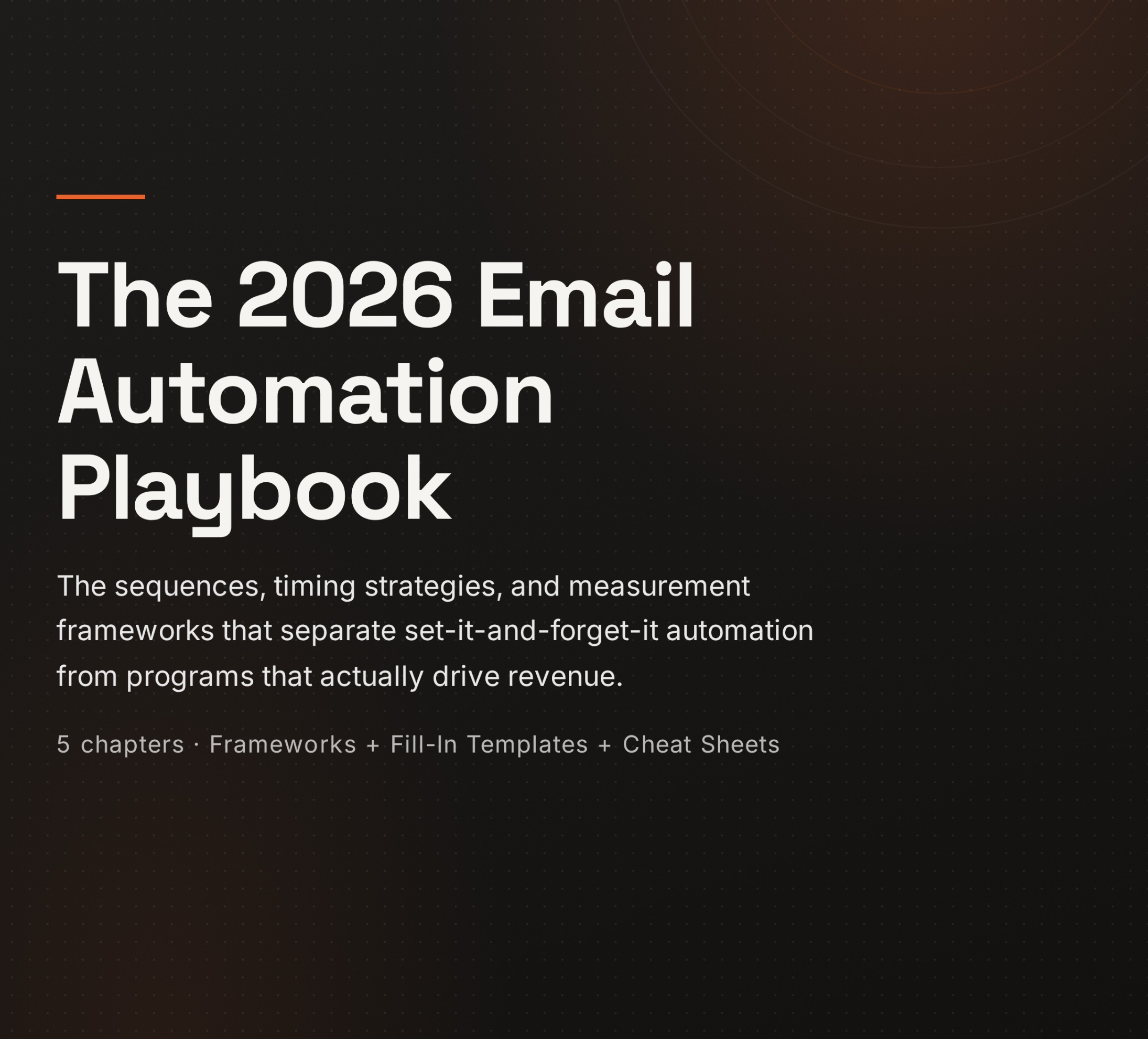
The 2026 Email Automation Playbook
63% of companies use automation. Few run it well. This playbook gives you the sequences, timing strategies, and measurement frameworks to close the gap — with fill-in templates, priority matrices, and cheat sheets you can put to work immediately.
Free DownloadGet your free copy of the guide
The Automation Priority Matrix
Stop building everything at once. Score your sequences by revenue impact, build complexity, and data readiness — then build in the right order. Includes a ready-to-fill Priority Matrix and Automation Readiness Checklist.
Sequences That Drive Revenue
Welcome series that set the trajectory, behavioral triggers that convert, and post-purchase arcs that drive repeat revenue. Each chapter includes timing benchmarks, sequence blueprints, and fill-in templates.
Win-Back and Measurement Frameworks
Recover disengaged subscribers before they damage your deliverability. Plus: the metrics that actually matter and a measurement system so you always know what's working and what needs attention.
What's inside —
The Automation Priority Matrix
Most automation programs stall because there are too many sequences to build at once. This chapter gives you a scoring system — impact, effort, data readiness — to decide which ones to build first, and a readiness checklist before you begin.
Welcome Sequences That Set the Trajectory
Welcome emails average a 50% open rate. This chapter covers the 5-Email Welcome Architecture, spacing strategy, and how to pair RoblyAI send-time optimization with OpenGen to recover non-openers on the most critical touchpoint.
Revenue Sequences
Post-purchase arcs, abandoned cart flows, browse abandonment triggers, and behavioral decision trees. Includes a Revenue Sequence Cheat Sheet with timing sweet spots and expected open rates for each sequence type.
Win-Back and Re-Engagement
30–40% of a typical list is disengaged — and sending to them damages deliverability for everyone. This chapter covers engagement tier definitions, the 3-Stage Re-Engagement Sequence, and when to sunset vs. suppress.
Measuring What Matters
Stop obsessing over vanity metrics. This chapter gives you the measurement framework to evaluate each sequence, the KPIs that indicate real performance, and a system for knowing when an automation needs attention.
Download your free copy
Built for email marketers who are already running automation but not getting the results the benchmarks suggest they should. If you want to move beyond basic sequences and build a program that actually drives revenue — this is the playbook.
Get your free copy of the guide
%202-1.png)
What You'll Learn
A step-by-step framework for prioritizing, building, and measuring email automation sequences over a 90-day period.
Score and prioritize your automation opportunities
~2 hrsRate each potential sequence by revenue impact, build complexity, and data readiness on a 1-5 scale. Use the composite score to determine build order. Welcome sequences, abandoned cart, and post-purchase flows typically score highest.
Complete the automation readiness checklist
~4 hrsVerify prerequisites are in place: behavioral tracking, subscriber segmentation, sender authentication, list hygiene, and defined success metrics. Address any gaps before building sequences.
Build your first sequence
~2 weeksStart with a welcome series using a 5-email architecture spread over 10-14 days. Each email has a distinct purpose: deliver the signup promise, introduce the brand, provide value, build social proof, and present a conversion call to action.
Monitor and optimize against benchmarks
~2 weeksTrack performance against sequence-specific benchmarks rather than a single open rate target. Welcome emails should hit around 50% open rate. Test subject lines and adjust timing based on early data before adding more sequences.
Expand to revenue and re-engagement sequences
~4 weeksBuild your second and third automations based on priority scores. Post-purchase flows, behavioral triggers, and re-engagement programs each have distinct timing, content, and measurement requirements.
Establish a measurement system and quarterly audit
~4 hrsSet up an automation scorecard tracking engagement, conversion, and health metrics for every active sequence. Run your first quarterly audit covering performance trends, link integrity, trigger accuracy, content freshness, and deliverability signals.
People Also Ask
Robly — Email Marketing For Everyone. Start Free Trial.
Try Robly free for 14 days and see why thousands of businesses trust us with their email marketing needs.
Start Free Trial
Rated 4.5/5
900+ Reviews

Rated 4.6/5
400+ Reviews

Rated 4.6/5
400+ Reviews

Rated 4.5/5
900+ Reviews

Rated 4.5/5
900+ Reviews
